Every pet owner has probably been faced with the dreaded challenge of urine on their carpets, sofas, or rugs. Not only do these "accidents" leave unsightly yellowish rings, but they also give off a persistent and highly unpleasant odor that seems to amplify on humid or hot summer days.
Despite your best efforts with traditional household cleaners, it often feels like the smell always somehow comes back. Why is it so difficult to get rid of a pet urine stain for good? In this comprehensive guide, Service ProVapeur dives into the science of cleaning and reveals the true methods (alongside the popular myths you must avoid) to salvage your textile investments.
1. The Science of Urine Stains: Why Are They So Stubborn?
Dog and cat urine is not just water. It contains a complex mixture of biological ingredients that, as they dry, change their chemical structure entirely:
- Urea: A sticky substance responsible for the yellow stains or discoloration of the fibers.
- Urochrome: The primary pigmentation agent in urine.
- Uric Acid (Crystals): The real culprit behind the odor that refuses to disappear.
The Cycle of Uric Acid Crystals
When urine dries, the uric acid crystallizes. These crystals bind extremely tightly to the fibers of the carpet or the foam of your sofa. Standard household cleaners will wash away the urea and urochrome (meaning the visual stain might disappear), but they utterly fail to break down the uric acid crystals. The result? As soon as it gets hot or humid, the crystals react with the moisture in the air and start releasing ammonia gas all over again. The smell magically reappears!
2. What You Should ABSOLUTELY NEVER Do
When an accident happens, panic often drives us to grab the first commercial product under the sink. Here are the classic mistakes that will worsen the situation, sometimes irreversibly:
Mistake #1: Using Bleach
Urine contains natural ammonia. Mixing bleach with ammonia creates a toxic gas that is highly dangerous to your lungs and your pet's. Furthermore, bleach does not destroy uric acid crystals; it will simply discolor your carpet for life and permanently weaken the synthetic or natural fibers.
Mistake #2: Cleaning with Ammonia-based Products
Ammonia is one of the main components of urine itself. If you clean the stain with a product containing ammonia (like many generic glass cleaners or multi-surface sprays), your dog or cat's brain will recognize this olfactory marker. To them, it will smell exactly like a sign saying "This corner is still the bathroom". They will inevitably return to mark the spot again.
Mistake #3: Scrubbing Vigorously
Friction opens the synthetic or natural fibers of your carpet like a frayed paintbrush, permanently damaging the texture. Moreover, frantic scrubbing only pushes the urine deeper into the carpet padding where no surface product will ever be able to reach it.
3. The Only True Effective Solution: Enzymatic Cleaners
If soap, vinegar, baking soda, and bleach aren't enough, what's left? The answer lies in biology: Enzymatic or Bio-enzymatic Cleaners.
These products do not simply mask the odor with a strong floral perfume. They contain "good" bacteria that produce enzymes (proteins that accelerate chemical reactions). These enzymes literally target the uric acid molecules and devour them, breaking them down into oxygen and carbon dioxide—gases that then safely evaporate into the air, eliminating the stain AND the odor at its source permanently.
4. Our Expert Step-by-Step Protocol for a Fresh Stain
Did your pet just have an accident right in front of you? Here is how to react surgically:
Step 1: Absorb the Excess Liquid (Blotting)
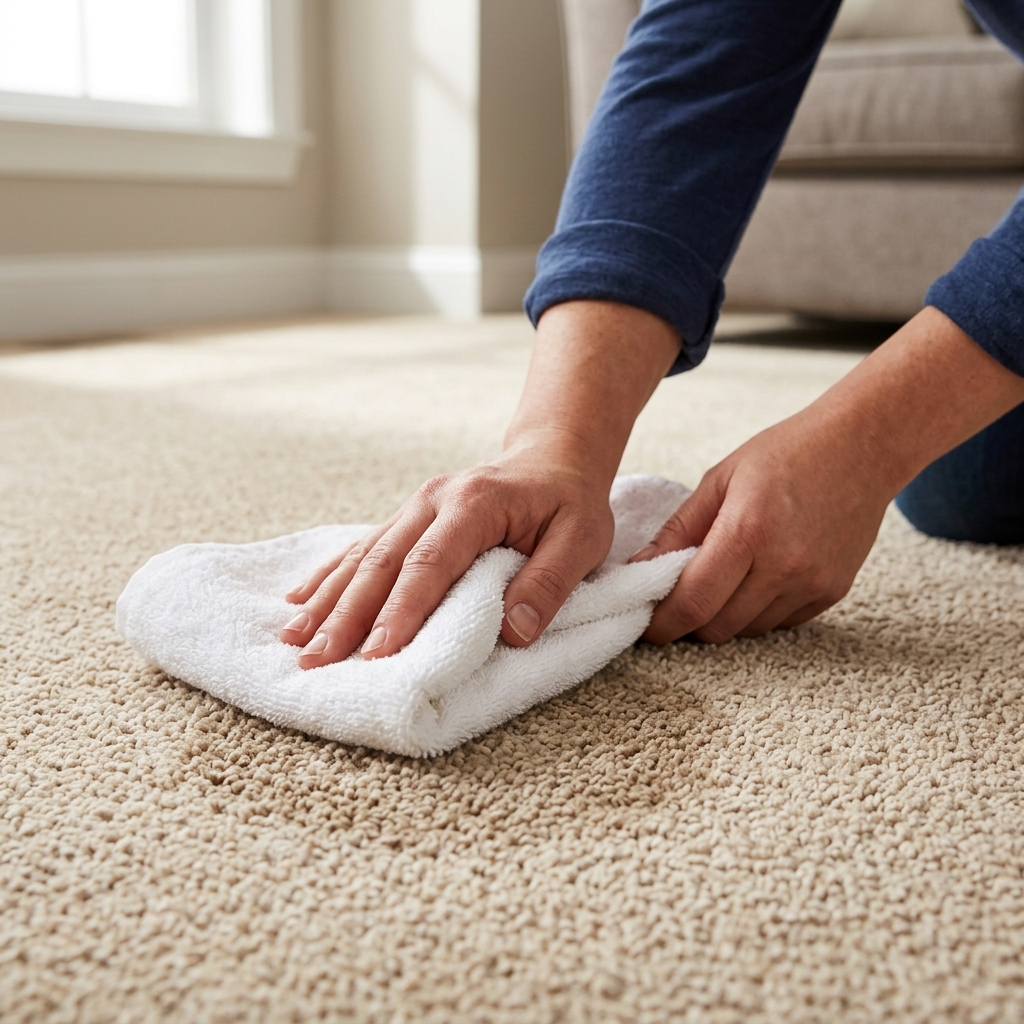
Immediately use a clean, thick, plain white, and dry towel (or high-quality paper towels). Why white? Because you need to verify if the stain is transferring onto the fabric, and you want to prevent the dye of a colored cloth from bleeding onto your beige carpet. Place several layers over the stain and press straight down, using your body weight. Hold for several seconds. Repeat with dry sections of the towel until almost no moisture is transferred.
Step 2: Temporary Vinegar Saturation (Optional)
If you are waiting to purchase a quality enzymatic cleaner, a temporary home remedy is to mix 50% white vinegar and 50% water. Pour it very lightly to neutralize the high alkalinity of the fresh urine, then blot again after a few minutes. Be warned, this will not replace the final job of an enzyme cleaner, but it will temporarily neutralize some of the initial odor.
Step 3: Massive Application of Enzymatic Cleaner
Enzymes need to be in physical contact with the molecules to work. You must ensure that the product penetrates as deeply as the urine itself did. If the urine has soaked down to the sub-pad, the cleaner must reach it. Pour generously around the perimeter of the stain to circle it, then pour in the center.
Step 4: Let the Chemistry Work... For a Long Time
The most common mistake is to spray the product, wait 2 minutes, and wipe it up. Enzymes need moisture to survive and remain active. Cover the sprayed area with a damp towel, or even an upside-down plastic tray, to prevent the product from drying out too quickly. Let it sit for 12 to 24 hours depending on the manufacturer's instructions.
Step 5: Extraction and Rinsing
Once the urates have been fully degraded, blot up the excess, then rinse if necessary with a tiny bit of cold water before doing a final dry blot.
5. When Should You Call a Professional? (ProVapeur to the Rescue)
Treating a small, fresh surface stain is within everyone's reach with the right instructions. However, you should absolutely call our expert technicians in the following cases:
- Widespread Odor: If you smell urine when entering the room but can no longer pinpoint the origin of the stains on the floor (the crystals are invisible to the naked eye but highly reactive to humidity). We use specialized UV blacklights to map out each infiltration zone accurately.
- Deep Infiltration: If the cat regularly urinates on the sofa, the liquid has seeped into the heart of the thick polyurethane foam. A commercial surface spray will never reach the source located 4 inches deep. Service ProVapeur uses ultra-powerful vacuum injection and extraction methods to remove fluids from the very core of your furniture.
- Highly Expensive Rugs: Oriental rugs or genuine wool rugs react very strongly to acidity and humidity. If the rich colors "bleed" under the effect of a poorly applied home remedy (containing an inappropriate pH), the rug will be permanently ruined.
Odor Still Lingering? Don't Replace Your Furniture!
Thanks to our industrial-grade enzymatic products, we have saved hundreds of carpets and sofas from the landfill. Call Service ProVapeur today to restore a brand-new smell to your home.
📞 (514) 246-4440 - Instant Free Estimate